

| Luristan Iron Swords |
| ||||
Some General Observation, Some Details and Some Speculations |
||||||
|
I acquired my first Luristan Iron Mask Sword (IMAS) in 2015. I was already fascinated with these early manifestations of the iron age and that has not changed. Now it is 2025 and I could look at many more IMAS, | |
|
I even managed to get a scientific project funded that allow a close look at some IMAS (most of which are now in the Brussels / Belgium Royal History Museum. | |
|
IMAS come up in numerous modules of this hyperscript and, to be honest, I have kind of lost track of all the stuff I have written in the last 10 years. This module tries to summarize the data obtained from the IMAS I could personally look at in some detail. There are also a lot of new discoveries I made more recently. | |
|
Below you finds: | |
|
1. A table supplying links to detailed descriptions to those Luristan swords that I could investigate to some extent. Please excuse alt he typos you might encounter. My eyesight is now (2025) so poor that I cannot easily read what I’m writing in my html editor any more. | |
|
2. Some generalization about the findings | |
|
The files you can open with the links are a hodgepodge of some old notes, stuff from projects, pictures floating around in my PC, and, in many but not all cases, notes and pictures that are fairly new. These swords, in the fullness of time, will go to some museum and I just want to make sure that the relevant information I gathered is preserved. | |
Links to the Iron Mask Swords (IMAS) Modules | ||||||
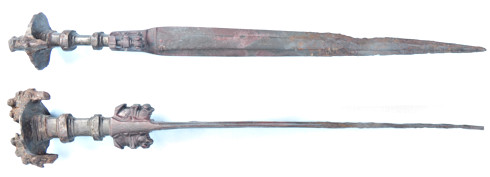
| IMAS 1 | My No. 1. A very well preserved "classic" mask sword, encountered in
various modules before. Very well preserved "lanimals" New features have been discovered: “Wormholes” and a complex way of doing the “crimping”
| |||||
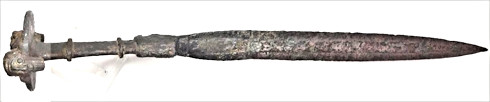
| IMAS 2 | Almost as good as IMAS 1 but the blade is broken. Very well preserved heads.
| |||||
| IMAS 3 | Rather corroded but with one good head. Shows a few interesting features at the
joint of blade and hilt
| |||||
| IMAS 4 | Very corroded but showing a unique feature (dafter cleaning): Two dents in the
blade were repaired by inserting bronze pieces by soldering!
| |||||
| IMAS 5 | Rather corroded but with an interesting feature: It demonstrates that crimping
here was done by employing what I called a “crimping ring” or "ctimping plate".
| |||||
| IMAS 6 | A simple undercoated IMAS and rather corroded. However, the tip part of the blade
is well preserved and shows remarkable workmanship
| |||||
| IMAS 7 | This sword is not a real IMAS but nevertheless the key to Luristan swords. It
embodies several technologies not formerly encountered like a side bar made from (probably faggoted)
sheet metal. Highly interesting!
| |||||
| IMAS 8 | TThe “cut sword” from the Luristan
sword project. Supplied and still supplies sinsight and questions Both halfs are now with the Royal History Museum in
Brussels
| |||||
| IMAS 9 | Used in the “Luristan Project” for C14 age determination. Age found
was 1427 – 1303 BCE ; much too old. Probably “contamination” with old carbon from ore, limestone, …
Some metalographic data.. Now with the Royal History Museum in Brussels
| |||||
| IMAS 10 | Used in the “Luristan Project” for C14 age determination. Age found
was 1745 – 1533 BCE ; much too old. Probably “contamination” with old carbon from ore, limestone, …
Some metalographic data. The “grip” of the hilt shows some texture (banding). Now with the Royal History Museum in Brussels
| |||||
| IMAS 11 | Used in the “Luristan Project” for C14 age determination. Age found
was 1006 – 901 BCE; about right if still somewhat too old. But that result tells us that IMAS could have been made
after 1000 BC but not before. Some metalographic data. Now with the Royal History Museum in Brussels
| |||||
| IMAS 12 | A simple undercoated IMAS very similar to the one investigated by Mareyon et al. but
with a completely different construction . X-rays were taken. Now with the Royal History Museum in Brussels
| |||||
| IMAS 13 | Extremely corroded; lost one “lion”. Perfect for destructive analysis
like age determination from several areas . Now with the Royal History Museum in Brussels
| |||||
| IMAS 14 | Very corroded bade but good hilt. Somewhat unusual tapered grip part. Now with
the Royal History Museum in Brussels .
| |||||
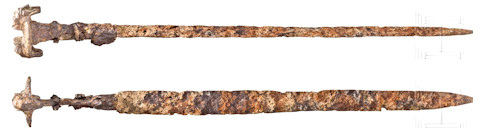
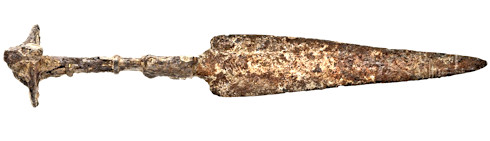
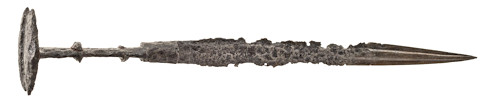
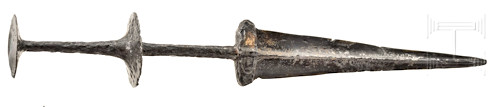
| IMAS 15 | This “double-disc-pommel” sword is technically not an IMAS; its origin
is more likely to be Hasanlu. I include it anyway because it (presumably)
belongs to the same time period and is technically rather advanced.
| |||||
General Remarks | ||
|
After studying Iron Luristan Mask Swords (IMAS) for more than 10 years, I still can find out new things about these fascinating objects. I also have acquired a few IMAS myself (to save them from destruction and to make them available for serious research at some time), and looking at them every now and then still fills me with wonder about the workmanship they embody. Herr I will first give you some general remarks (most of them not new but already expressed here and there in this hyperscript). | |
|
Let's look at my general points. Here is the list: | |
|
||
|
In what follows I will briefly comment on those points. | |
|
For the sake of clarity and brevity. will make clear statements that are mostly not absolute truths but just “high probability”. I will thus not discuss the validity of everys tatement; you will find a lot of that in the remainder of the hyperscript | |
| 1 | All IMAS or Luristan type I swords were found in Luristan and
never exported, in contrast to type II swords. In this link tha types are explained. | |
|
Even so archaeologists have only unearthed one IMAS (in the rubble left by grave robbers), we can be reasonably sure that all IMAS come from graves in Luristan proper. Either nobody outside of Luristan wanted to own one of these rather precious if somewhat peculiar items, or outsiders were just not allowed to possess one of those “holy” (?) objects. The same is true for the many "Master of Animals” bronzes – none has been found outside of Luristan. However, Luristan type II swords, bronze daggers, and other objects were traded far and wide, it seems. I think this is a real puzzle. | |
| 2 | None of the many sculptures and reliefs from roughly 800 +/- 100 BC show some individual carrying an IMAS | |
|
Well, I certainly haven’t seen all sculptures and reliefs from that time. But I have seen quite a few. You may find all kinds of swords associated with some guy, including Luristan type II swords, but never an IMAS. Check the gallery here. Obviously, high ranking guys (no others were depicted wearing a sword), did not sport an IMAS. | |
|
Now, an IMAS was certainly not used for fighting. They must have been far too precious for that, not to mention that they are not particularly good for that. Could it be that those swords were not part of some dress code either but kept in a shrine, or exclusively used for burials? They would have been someway awkward to wear anyway, since the figures on one side would “look” into your belly | |
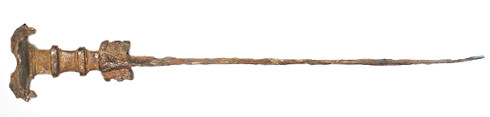
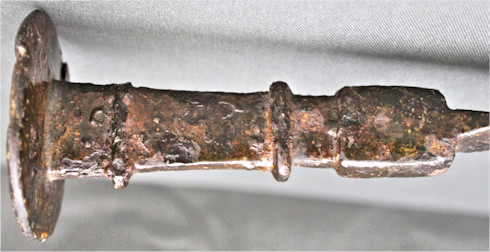
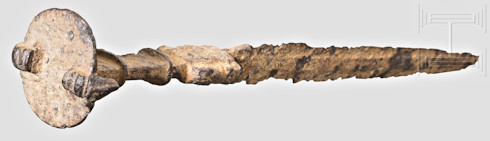
| 3 | The male head and the “animal” so typical for IMAS have no counterpart whatsoever in the antique world around 1000 BC. None of the thousands of Luristan bronzes shows figures of this typer eithther | |||||||||||||||||||||
|
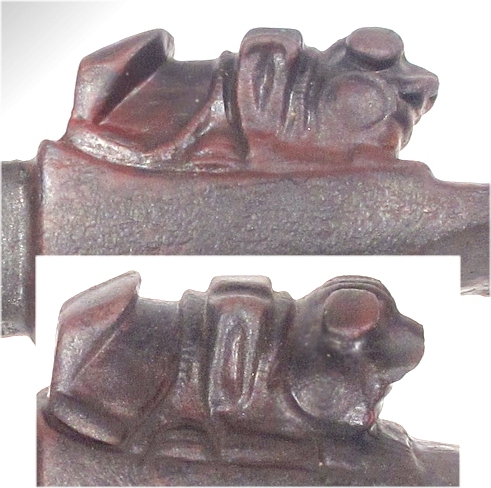
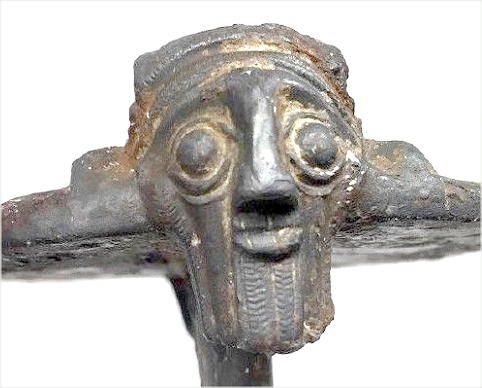
Classical archaeology sometimes make some vague claims that there is some relation to Assyrian figures or other products. I beg to differ and challenge everybody out there to produce something non-Luristan that looks even remotely like the “lion” or “animal” on an IMAS. To make things even worse, neither the head nor the “animal” on an IMAS bears any resemblance to heads or animals appearing on the many Luistan bronzes. | |||||||||||||||||||||
|
Here are a few pictures just to illustrate what I mean: | |||||||||||||||||||||
| ||||||||||||||||||||||
|
If you look at the combination of head and animal, thee is just nothing that
comes close. I could make similar statements regarding the “Master of Animal” bronzes. Nothing ever found outside of Luristan resembles the whole thing nor its parts (heads, animals, …). |
|||||||||||||||||||||
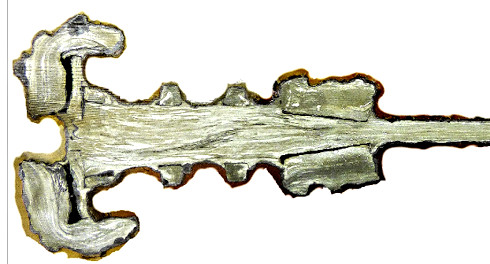
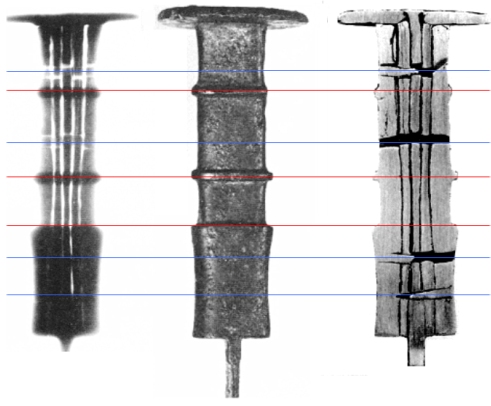
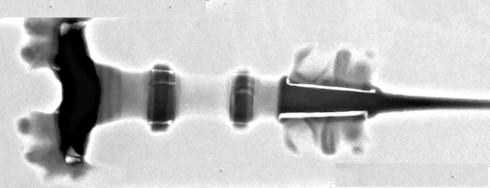
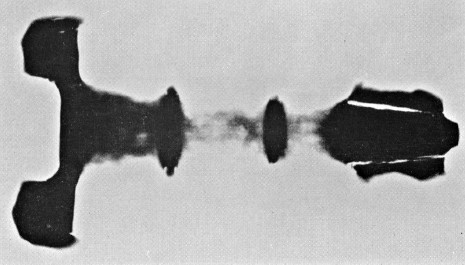
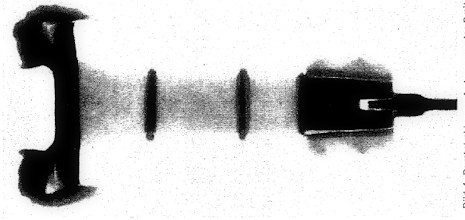
| 4 | X-ray images (or some cuts through the hilt) , as far as available, show large empty spaces inside around the figures or the rings around the hilt - but on the outside you do not see anything. | |||||||||||||||||||||||||||||||||||||||||
|
We only have a few X-ray pictures (or major cuts) But whey we have shows large internal cavities that do not show in the outside | |||||||||||||||||||||||||||||||||||||||||
| ||||||||||||||||||||||||||||||||||||||||||
|
We must conclude that the old Luristan smiths made show pieces. Only what is visible matters. This entails that they could judge the qualtiy of their raw material very well. | |||||||||||||||||||||||||||||||||||||||||
|
Actually, some time after I had written this, I found a simple explanations for the empty spaces! Check IMAS 5 | |||||||||||||||||||||||||||||||||||||||||
| 5 | Different technologies were used for rather similar looking swords | |||||||||
|
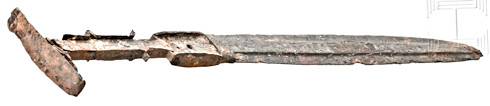
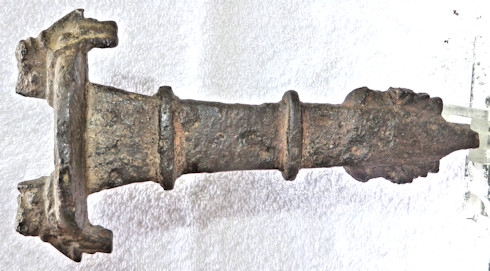
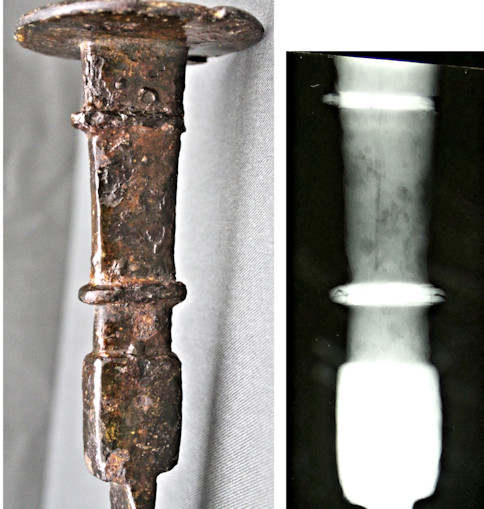
The example of one of the sword above shows a hilt made by riveting several layers
together, in contrast to most other MAS. It is actually the only known example for this technique. It possibly was an early
example as it is without decorations. A very similar sword to the one above (IMAS 12, now in the Brussels museum) exhibits a completely different design as shown by the X-ray analysis; see the picture below. Crimping appears to gave been done in more or less complex ways, too. However, far more studies would be needed to clarify this point since we do mot yet know the internal composition of most IMAS. | |||||||||
| ||||||||||
| 6 - 10 |
The crimping is always masterfully done but with different and
rather tricky technologies Gross shape made by sheet metal cutting, stacking and welding (?) Extremely fine work is done. Think of gold smith and not of black smith IMAS makers must have had access to a very powerful grinding and polishing technology What did new IMAS look like? All shiny or with some features highlighted by paining? |
|
|
I won’t go into this here. Check IMAS 6 for some details about crimpimng including a new suggestion of how it was done at least sometimes. The other points are either self-explaining or also treated in the various modules accessible form this link hub. | |
 First Iron Swords - Reliefs / Sculptures with Swords and Daggers
Luristan Project - Large Pictures
New Interpretation of Master of Animals Figures
© H. Föll (Iron, Steel and Swords script)



 With frame