Early Iron Sites
Hattusa

- The Hittites had all but vanished from human memory already during classic antiquity - despite the fact that they once controlled a mighty empire! Only a few obscure lines in the Bible left some hints.
- Even the early archeologists, who already knew plenty about the ancient Mesopotamian and Egyptian cultures, had no clue or misread whatever there was.
- While the existence of the Hittites slowly became known at the end of the 19th century, the turning point was the discovery of the royal (Hittite) archives in Hattusa by the German archeologist Hugo Winckler. While written in the by then familiar cuneiform, their language was unknown but was the same as the language used in some letters found in the Egyptian Royal archives in Amarna. A Hungarian scientist, Bedrich Hrozný, figured out the language and made it common knowledge in 1917.
- Nobody really knows where the Hittites came from and how they somehow crowded out the Hattian culture in Anatolia, starting around 1800 BC. Their language is of the Indo-Germanic type while that of the Hattians was not. That makes sure that those cultures have different roots.
- It is also not clear why the Hittites sort of vanished around 1200 BC for good without leaving lasting memories and few recognizable remains.

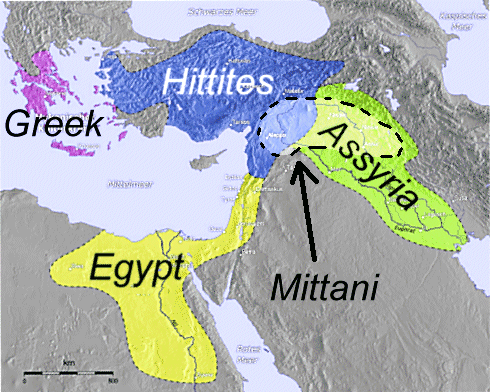 | |
| The major empires shortly before 1200 BC
The rough extent of Mittani before it was swallowed by the others is also shown | |
| Source: Wikipedia and others |
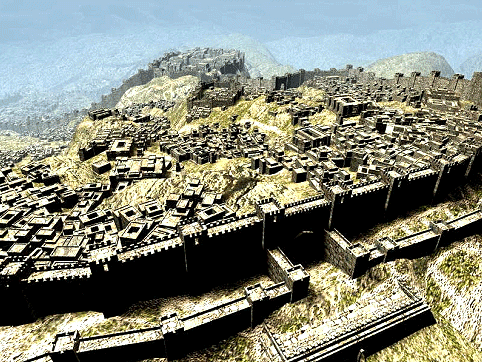 | |
| What Hattusa must have looked like | |
| Source: Tourist information in the Web. |
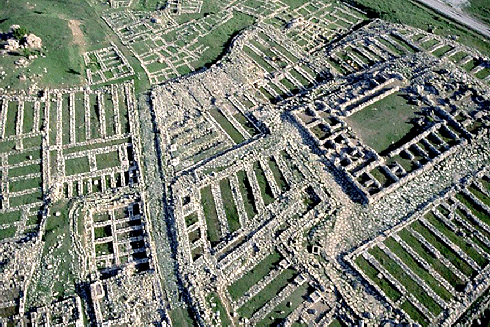 | |
| Some present day day remains after excavation and partial restoration. On the left is the big temple of the lower city | |
| Source: Tourist information in the Web |
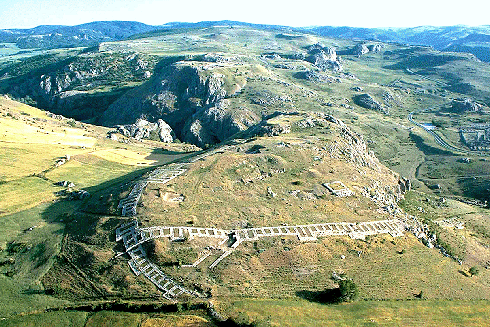 | |
| The "Büyükkaya" (= big rock) part of Hattusa) | |
| Source: German Archeological Institute |
 |
|
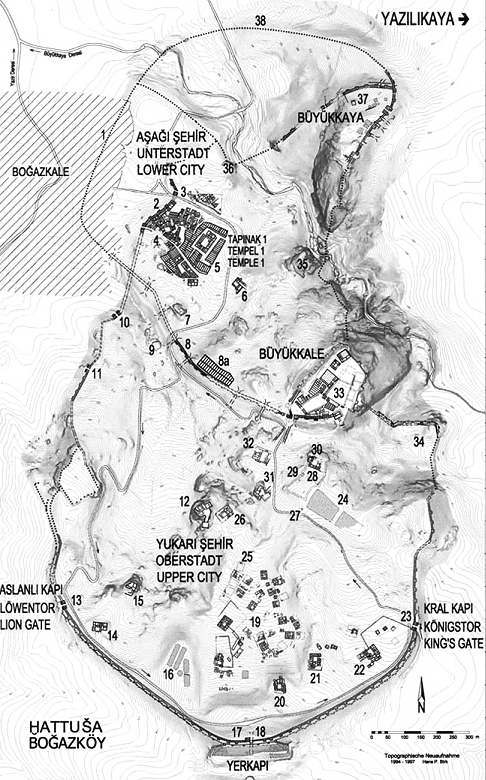
| Plan of Hattusa with excavates structures. "Büyükale" was the fortified place of the King. | |
| Source: German Archeological Institute |
There is a lesson for engineers in there somewhere.
 With frame
 Critical Museum Guide