| |
|
| |
Athens |
 |
There are plenty of museums in Athens, even if you don't count the Acropolis plus
sundry ancient temples and buildings. Here I only consider the National Archaeological Museum of Athens and the Museum of
the Ancient Agora in the so-called "Stoa of Attalos". The stoa was a covered walkway or portico in the Agora of
Athens, originally built by and named after King Attalos II of Pergamon, who ruled between 159 BC and 138 BC. The current
building was reconstructed in 1952–1956 by American architects and is quite spectacular. |
|
 |
Everybody with a halfway decent education would expect that major archaeological museums in the capital
of Greece would have a lot of very good stuff on exhibition. People familiar with museums in Southern Europe would also
expect a bit of laisser fair, closed rooms, missing explanations, bad descriptions and so on. Both expectations are met
by the museums I visited.
The National Archaeological Museum is the bigger one; it too is housed in an imposing building: |
| |
|
|
|
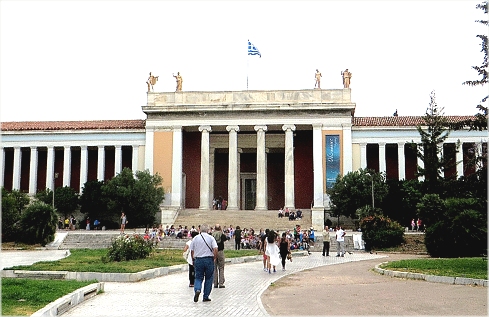 |
| National Archaeological Museum in Athens |
| Source: Photographed in Athens: May 2017 |
|
| | |
|
|
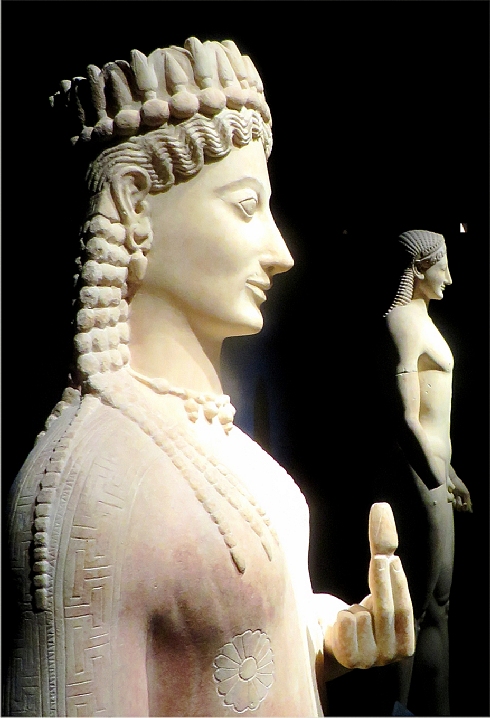
The museum is full of breathtaking things that are not connected
to swords and metals, and I will give a tiny impression of that before I turn to our topics of interest. |
| |
|
|
|
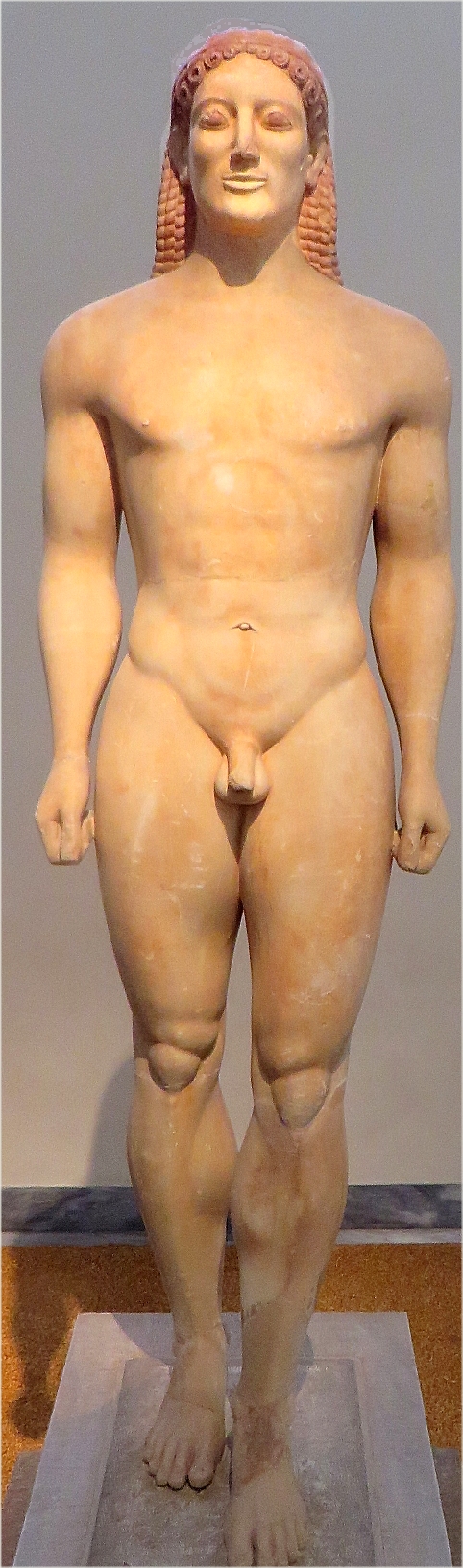 |
What you would expect: a perfect Kouros
About 530 BC |
| Source: Photographed in Athens: May 2017 |
|
| | |
|
| |
|
|
| | |
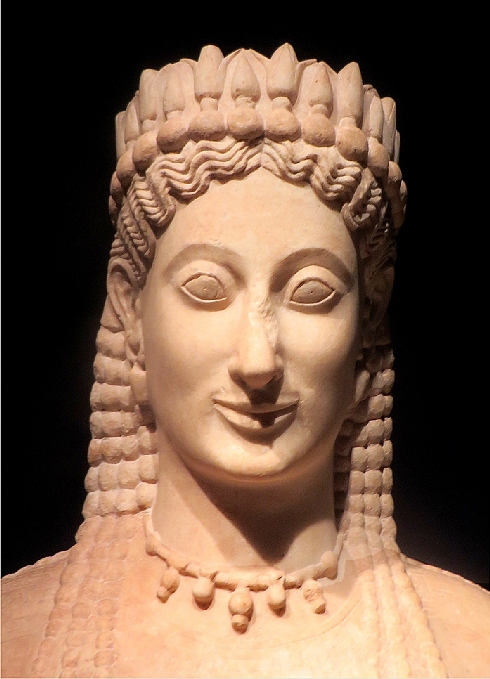 |
| Female companions of the guy from above (sort of) |
| Source: Photographed in Athens: May 2017 |
|
| |
|
|
Enough pure art. Let's have some metal. The bronze casts below are just marvellous. |
| | |
|
|
|
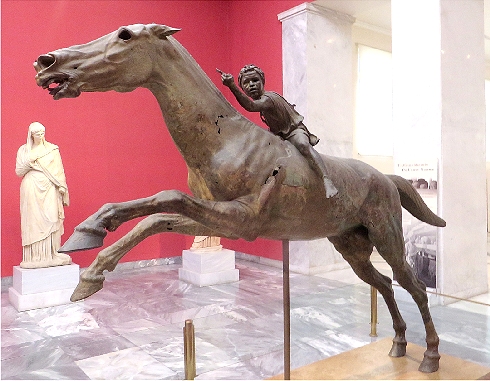 |
| Bronze statue of a horse and a young jockey. about 140 BC |
| Source: Photographed in Athens: May 2017 |
|
| | |
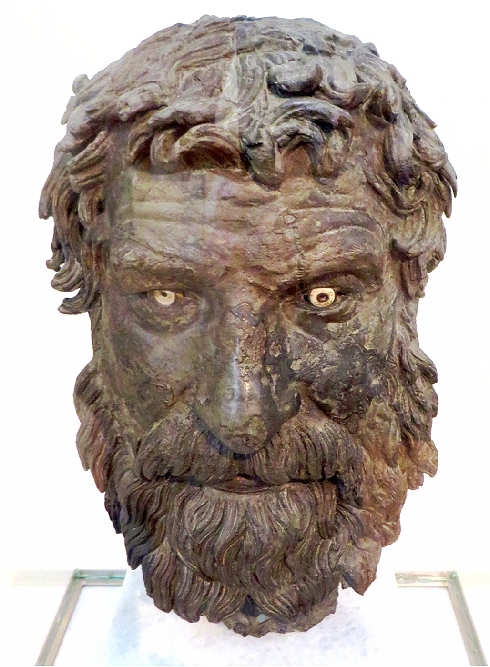 |
Ancient Materials Science Professor from around 240 BC
(The museum calls him a
philosopher but I think he must have been better than that and promoted him ) |
| Source: Photographed in Athens: May 2017 |
|
| | |
|
|
Now let's look at the mist enigmatic bronze object ever discovered: the "machine
from Antikythera": |
| | |
|
|
|
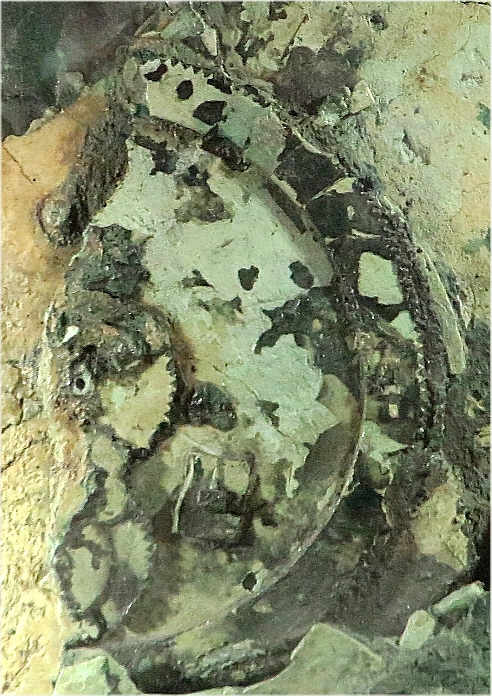 |
Machine from Antikythera; around 100 - 200 BC
|
| Source: Photographed in Athens: May 2017 |
|
| | |
|
|
|
This might look rather unassuming but it is actually part of a system of at least 30 meshing
bronze gears - the world's first analogue computer, in fact! It was recovered on May 17, 1901 from the Antikythera shipwreck
off the Greek island of Antikythera, and not noticed for what it was for quite some time. Rather recent research using computer
tomography found out that it was a complex astrolabe (look it up) and makes much of the complexity of the system, but fails
to mention that "30 meshing gears" would only move if the whole thing was made to perfection and with rather good
bearings. Otherwise friction will kill it right away.
The machine from Antikythera is still a major enigma, Nothing
like it has ever been found elsewhere. "Machines" with similar complexity did not appear in the "!West"
before. let's say, the 17th century AD. |
|
But now to iron, steel and swords. First some bronze swords |
| | |
|
|
|
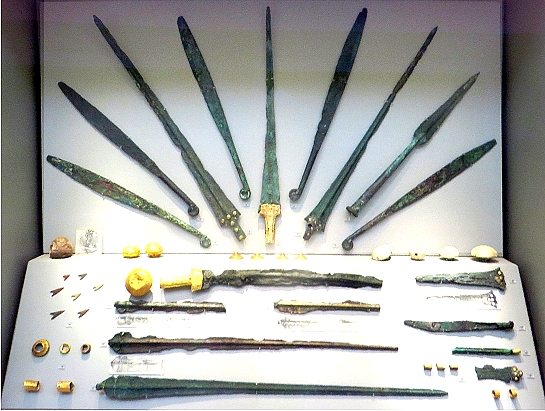 |
Some of the many bronze swords on display
Large picture |
| Source: Photographed in Athens: May 2017 |
|
| | |
|
|
|
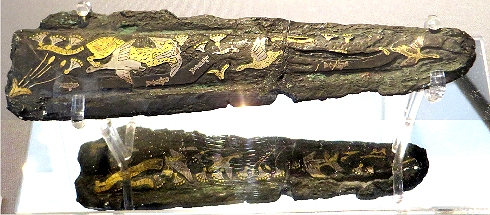
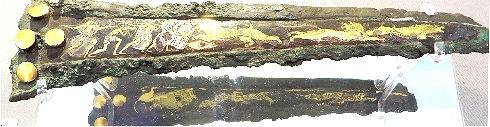
The museum has plenty of bronze swords on display. Quite a few show fancy
(gold) hilts or other artwork. Besides the more usual shapes we find very long and slender swords and some makheiras (see above). I have not seen a xiphos,
however - but not all rooms were open!
The famous pieces are the ones shown below: |
| | |
| | |
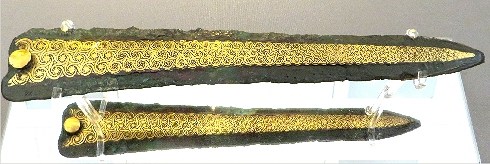 |
 |
 |
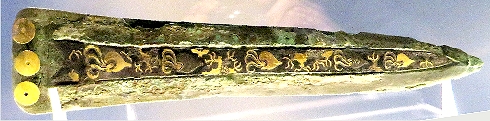 |
Decorated bronze daggers / swords
Large pictures |
| Source: Photographed in Athens: May 2017 |
|
|
|
|
|
All these beauties are from Mycenae graves. Mycenae is now an archaeological
site, located about 90 kilometres (56 miles) southwest of Athens. Mycenae was one of the major centres of Greek civilization
in the period from about 1600 BC to about 1100 BC. To some extent it supplanted the older Minoan
civilization (2600 to 1100 BC). In fact, the Minoan palace (in Knossos / Crete) was occupied by the Mycenaeans around
1420–1375 BC. |
|
What about iron objects? Well - forget it. Among the stuff I
could see (some parts of the museum that contained weaponry were closed;) there was nothing remarkable. The best I can come
up with is a (ceremonially killed ?) kopis:
|
| | |
|
| |
|
 |
Iron kopis; late 4th century BC
Large version |
| Source: Photographed in Athens: May 2017 |
|
| | |
|
|
|
According to the text, this is an "Iron sabre with a bird-shaped handle.
Late 4th century BC". OK. |
|
So much for the National Archaeological Museum. Now let's give the
"Museum of the Ancient Agora" in the so-called "Stoa of Attalos" building a quick look. It does contain
interesting objects. There are plenty of ceramic objects and some of them are not great objects of art but far more important
utility items: |
| |
|
|
|
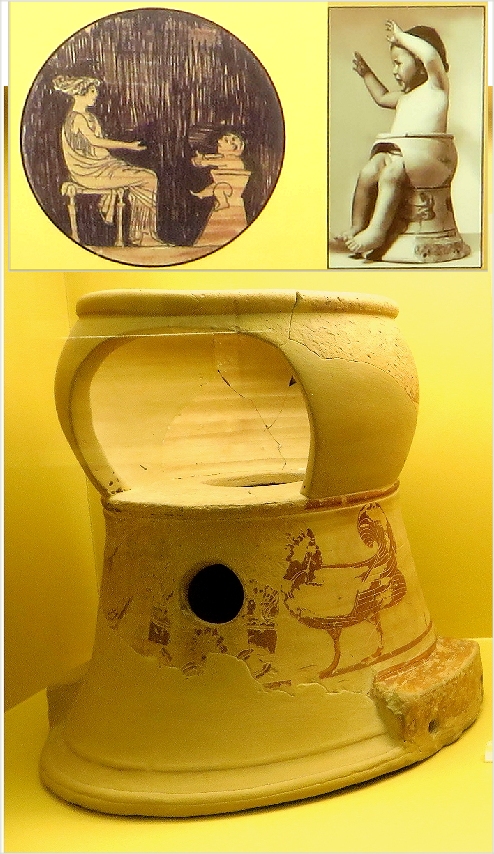 | | Not very artistic but very useful |
| Source: Photographed in Athens: May 2017 |
|
| | |
|
|
As far as iron, steel and swords are concerned,
the Stoa museum contains a truly remarkable object. Here it is: |
| | |
|
|
|
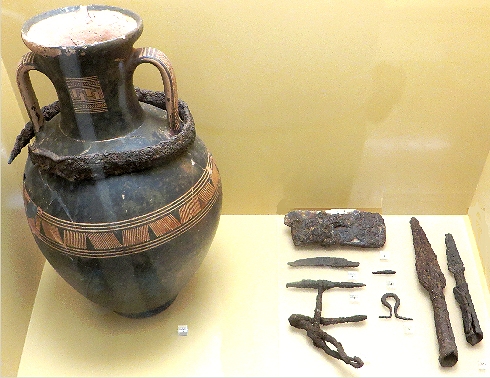 | Finds form a ca. 900 BC tomb
Large version |
| Source: Photographed in Athens: May 2017 |
|
| | |
|
| |
|
The Museum provides the following explanation:
Finds from an early geometric cremation burial of a warrior craftsman. About 900 BC.
1 - 2: ash
urn (neck amphora) and iron sword; 3: iron set of horse bits; 4: iron pin; 5 iron fibula, 6: iron chisel; 7: iron knife;
8: iron axe; 9-10: iron spearheads. |
|
You are not sure why these rusty things are remarkable? So look at
large version pictures. You are still not sure? So let me tell you: |
| | |
|
|
|
This is the oldest (big) iron sword
I'm aware of
|
|
| | |
|
|
|
The Luristan swords
might be older but we do not know that for sure. There might have been plenty more iron swords from 900 BC or even older
that we are just not aware of. Maybe because they are rusting away in some museum basement or because they never have been
found. Recall that practically no iron weapons of major powers
around then (Hittites, Assyrians, Babylonians, Egyptians; ...) are known. All we seem to have are the iron double pyramid bars from the Assyrians dating to about 710 BC. That is
200 years later but the magnitude of the find indicates that the technology for mass-producing iron must have been considerably older.
|
| | |
|
| |
|
|
The museum at the place where the Olympic Games took place in
antiquity is one of the great museums of Greece. It houses the artifacts found in the archaeological site of ancient Olympia.
This includes marvelous non-metal things: |
| |
| |
| | |
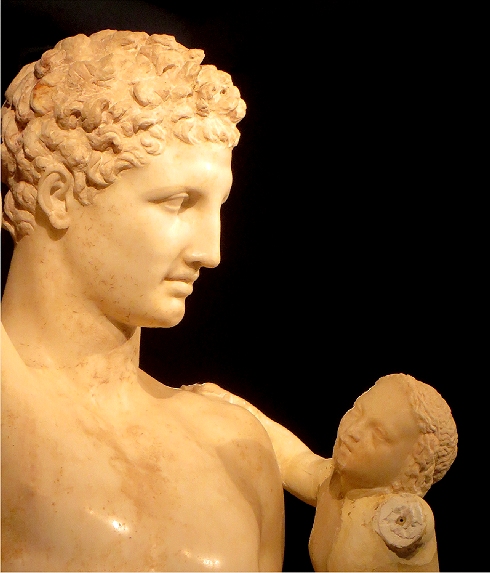 | Hermes by Praxiteles
Large version |
| Source: Photographed in Olympia; May 2017 |
|
| | |
|
|
|
Praxiteles was
the most renowned of the Attic sculptors of the 4th century BC. The sculpture above shows Hermes (a Greek God; look it up
yourself) with the young Dionysus (a Greek God etc.). Not everybody believes that it was done by Praxiteles - but so what.
It is absolutely breathtaking. |
|
Among many other noteworthy things you find a large
collection of bronze helmets; here is one example: |
| |
|
|
|
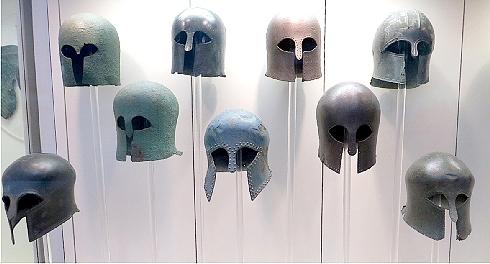 |
Bronze helmets
More among the large
version | | Source: Photographed in Olympia; May 2017
|
|
| | |
|
|
How about iron, steel and swords? Nothing to rave
about but at least some objects: |
|
| |
| |
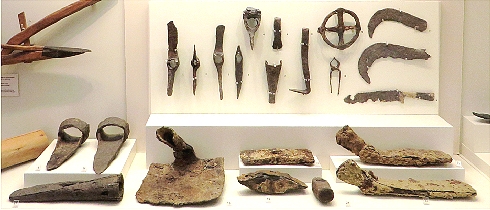 |
Some iron tools
More among the large
version | | Source: Photographed in Olympia; May 2017
|
|
| | |
|
|
So, all things considered, the Greek museums are all worth a visit.
They are pretty good. Just not as good as they could be. |
| |
|
© H. Föll (Iron, Steel and Swords script)
 With frame
 Critical Museum Guide