| | |
12.4.2 Dynamic Properties Combined |
| |
|
Graphics to Show it All |
 |
First let's go through the basic parameters that determine your swords dynamical properties: - Its mass
m. This is a single number, easy to obtain and typically between 1 kg
- 2 kg. Mass is a clear thing that does not need more words.
- The center of mass. (COM). Once more
a single number that gives the distance (in cm or mm) to some reference point. It is
also a sufficiently clear entity by now. Typically we want it on the blade but not too far from the hilt.
- The moment of inertiea
I. This is a measure of the distribution of the mass. It is not a single
unambiguous number and it is not all that easy to calculate. Its value (given in kgm2) is always relative to
a rotation axis. It is usually given with respect to a rotation axis through the COM at right angles to the blade and then
designated ICOM. If ICOM is known, it is then easy to calculate values
for other axes perpendicular to the blade at some arbitrary distance from the COM.
Generally we want a small moment
of inertia since this makes it easier to swing the sword.
- The effecive mass. This is not a number but a curve with a shape that is determined
by the mass and the moment of inertia of the sword. It gives values (in kg) that decrease from a maximum at the COM (with
a value equal to the total mass) to lower values at both ends of the sword.
The value of the effective mass at some
point relates to the impact felt at that point.
- Percussion points. There are always two points! One point is usually chosen as the pivot point
on the hilt close to the cross guard. The corresponding percussion point then is somewhere down on the blade (or even outside;
off the tip). Its distance from the center of mass depends on the mass m, the moment of inertia ICOM
relative to the COM, and the distance of the pivot point from the COM. We want the percussion point to be found in the tip
region because hits on the percussion point do not transmit forces to the hand at the pivot point.
- Vibration node points. Typically swordsmen
are concerned about the location of the two nodes of the (low frequency) second order side-to-side vibrations. They are
easy to excite and to see. The two nodes of the (high frequency) second order edge-to-edge vibration might be more important,
however. Luckily, they coincide more or less with the first variant. Ideally, we want the lower vibration node to coincide
with the percussion point.
Vibration node positions are not easily calculated.
It is also not easy to change their position substantially. They tend to be - very roughly - around the hilt and about 3/4 down the blade.
- Point of maximum impact. I have not discussed that yet but it is clear that whenever
you hit something you transfer some energy from your sword to the hittee. There must be a point somewhere on the blade that
delivers the most energy and that is the point of maximum impact. I'll discuss that later in detail.
|
|
 |
In essence, all these parameters result from the distribution of the materials
defining your sword. In other words: It is the shape or geometry that counts - and details matter! Change something there
and all the parameters above will change. Some more than others. |
|
What that means is simple. You cannot sit down, consider what you want with respect
to the parameters given above, make a list with the resulting numbers and curves, and order your sword maker to produce
a sword that meets your wishes. All these parameters are simply not independent. |
|
|
You must compromise. There is no "ideal" sword for you, only compromises.
Swords may give you satisfaction with regard to some parameters while leaving something to be desired with respect to others. |
|
Peter Johnsson has
come up with a very attractive way to illustrate the sword properties that result from Vincen Le Chevalier calculations 1).
His pictures are mostly published in "The Sword - Form and Thought" 2)
and I use some of them here with the kind permission of Peter, Vincent and the Solingen museum.
Here is what it looks
like with some explanations added by me: |
|
|
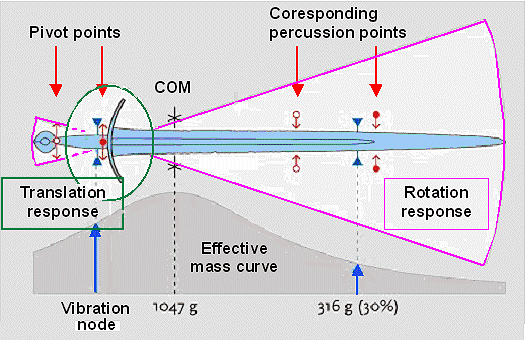 | | Sword dynamics graphically |
|
| | |
|
|
The text insets are from me and I used my nomenclature that on occasion is somewhat
different from that of Le Chevalier. Pictures like that are generated by a computer program that is available for everybody
in the Net 1). You must supply the basic data, of course, and that involves
some precise measurements. Le Chevalier has explained most of the math behind the calculations and, as far as I'm concerned,
it is sound.
There is a lot of information in these pictures. Let me go through the pertinent points:
- You see the basic shape of the sword in some detail and you find the mass.
- The effective mass curve is shown below the sword and the effective mass at some
special points may be given as a number and in percent of the full mass.
- The center of mass is indicated.
- Two pivot points are chosen, always close to the cross guard or to the pommel. The
corresponding percussion points on the blade are calculated and shown. Since the real
pivot point will be somewhere between the two shown, the blade part between the two percussion points is where you want
to hit (with some preference to the front one).
- The two nodes of the second order side-to-side vibration are shown.
- The sword's response to attempts at translations are shown as an oval centered at
the cross guard pivot point. The smaller the distance from the pivot point to somewhere on the oval, the harder it is to
move the sword in that direction.
For straight thrusts the full mass is used, for movements at 90o to the
blade the (reciprocal) effective mass in that direction is used. For movements in arbitrary directions, a suitable mixture
of the two values is employed. Assumed is that you just apply a force in the specific direction which, except for the straight
thrust, always results in translation plus some small rotation.
- The sword's response to attempts at rotations are shown as two cones centered at
the cross guard pivot point. The larger the cone, the easier it is to rotate the sword around the cross guard pivot point.
The essential parameter for this is the moment of inertia for rotations around the pivot point.
- Some more information, e.g.. effective masses at some special points, might be given as the need arises.
|
|
The power of these diagrams (from the Solingen book)
becomes clear when you use them to compare swords. |
|
|
The sword on top is described as a hand-and-a half Sword from 1480 - 1500. It
is 105 cm long with a the blade length of 81.5 cm and weighs only 0.822 kg
The sword on the bottom is actually an "Ulfberht" sword. Its length is 83.3 cm, with a 70.2
cm blade. It weighs in at 0.79 kg, quite low too.
The "Solingen Swords" Link provides a lot of pictures like
the ones discussed here plus some data. It includes very light and very heavy swords, long and short ones, and allows a
lot of data extractions like the one below.
Here are the two characteristics of these
swords: | |
|
| |
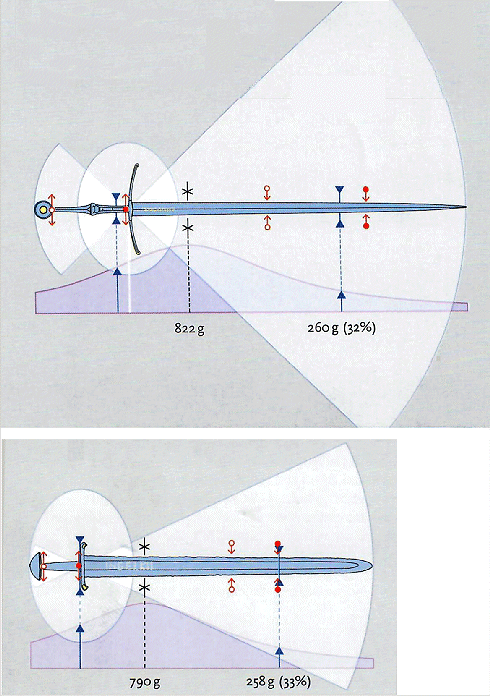 | Property comparison of a hand-and-a half Sword
from 1480 - 1500 and a Ulfberht sword from ca. 1000 AD. |
|
|
The Ulfberht has a slightly better translational response, simply reflecting its
slightly smaller weight. Its lower percussion point coincides with the vibration node but is a bit far from the tip. The
effective mass at the node point is respectable but practically the same as that of the longer sword. The long sword has
a far better rotation response. That means that you can get it to swing with a larger rotational speed than the Ulfberht.
Its percussion point (also close to the node point) thus moves considerably faster that that one of the Ulberht and thus
delivers far more punch (the power goes with effective mass and the speed squared!). It is just a much better sword - if
wielded by an expert. It needs more room for swinging and that needs practice. |
|
|
I doubt very much that the longer sword was intended for "one-and-a-half"
hands. There is actually ample space for two hands on the hilt but given its small mass I tend to believe that it is meant
for one hand only. Why then the long hilt? The answer is simple: |
| | |
|
| | |
Optimizing the dynamical properties of
your sword means optimizing:
the pommel and the
the blade taper
|
|
| |
|
|
|
The long sword obtains its superior properties to a large extent
because its pommel is far away from the center of mass without taking too much mass away from the blade. The blade is actually
thicker then the Ulfberht blade but more slender and cunningly tapered. There are many interesting pictures of people (including
angels) wielding those swords always with just one hand, here is the link. |
|
Finding the best pommel mass and distance plus a fitting taper Is not easy because
of all the parameter interdependence. There are no simple rules. I'll give you a few examples of what can be done. |
| |
| |
| | |
Optimizing Pommel and Taper |
|
I'll show you two pictures, one from the "Solingen
book" and le Chevalier's / Johnsson's work, the other one from Turner's
seminal contribution. |
|
|
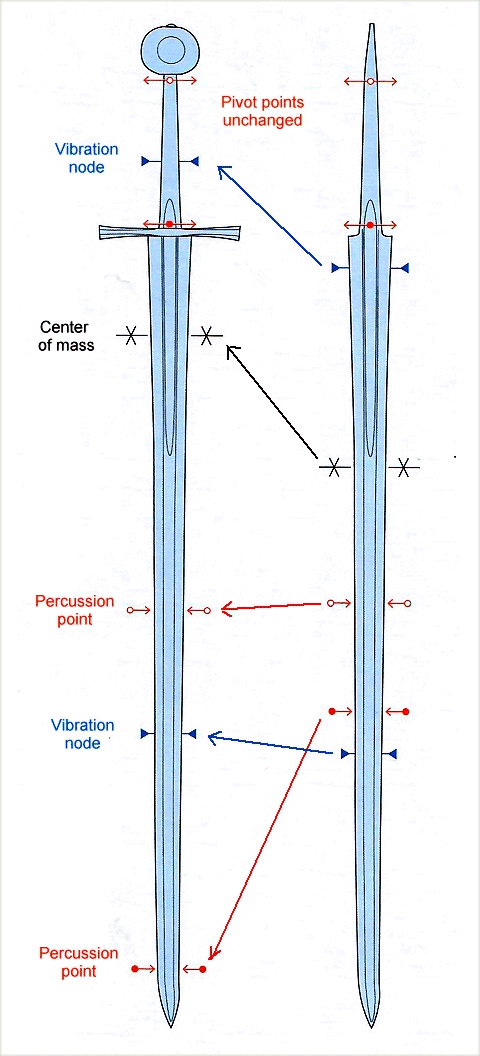 | | What a optimized pommel can do |
|
|
Unfortunately, the basic data of the sword are not given but it is quite obvious
that an optimized pommel will: - Add some mass, making the sword heavier and thus a bit less agile.
- Move the center of mass much closer to the hilt, substantially increasing agility,
- Move the vibration node close to the hilt "up" quite a bit into the hilt. This substantially reduces the vibration
amplitudes your hand will feel.
- The vibration point close to the blade tip only move a little bit "up" on the blade. You actually would like
it to be farther out and closer to the tip but there is no way to achieve this with a pommel. So be happx that it only moves
a little bit in the wrong direction.
- The percussion points move quite a bit down on the blade. That is good. Having a percussion point coincide with the
vibration node might be even better but for those kind of long swords this is not practical. Anyway, considering that for
a pivot point around the vibration node of the hilt, the percussions point will not be too far from the blade node, this
is quite acceptable.
|
|
|
We have a first quite instructive example for what can be done, and that you always must compromise. |
|
Turner looks a the effect of pommel from many directions (read his book if you want details). What I will show you from his work is what
a pommel will do to the effective mass: The pivot point here is assumed to be somewhere
between your wrist and your elbow but that doesn't matter much. |
| | |
| |
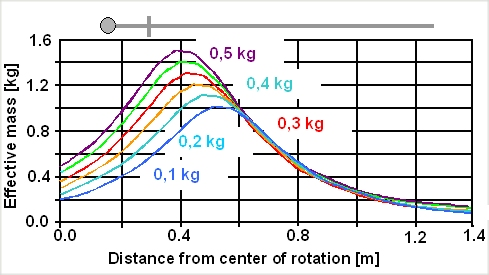 |
| Adding various pommels to a 1 kg blade and their effect on the effective mass |
|
| |
|
|
You see the increase in mass and the shift of the center of mass towards the hilt.
You also see a large increase of the effective mass around your hand position (around 0.3. m) that will decrease the translational
response (you more or less feel the full increase in weight there). The rotational response, , however, is far less impaired
because the COM gets closer to the hilt.
What you probably don't see is the 30 % increase in the effective mass at the
tip of the blade for the 0.5 kg pommel!
It is there, believe me, you just need to "enlarge" the tip region
in a (precise) drawing to see it. In other words: Increasing the weight of your sword by 50 % by a substantial pommel will
not impair maneuverability very much (far less then 50 %) while giving you 30 % more "punch" for hits close to
the tip region. That might well be worth the effort. |
|
|
We see once more the importance of optimizing the pommel or better yet, pommel and the rest
of the hilt. |
|
Far more could be said about pommel and hilt, followed by lengthy
discussions of blade design (length, width, thickness, taper on thickness and width, number and length of fullers, cross-sectional
geometry, ....) but I will have mercy on you (and me). I will just five your the results of extracting some data from the
wonderful work in the "Solingen book". |
| |
| |
| | |
|
| |
| |
|
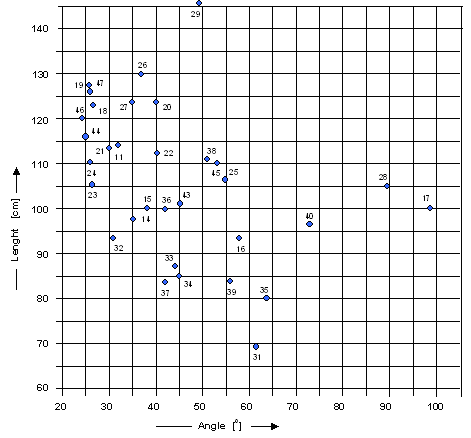
What I did was to measure the angle of what I have called the "rotational
response" in the drawing above. Then I plotted the length of the sword versus
this angle; the result is shown above.
I did the same thing for the relation between the "rotational response"
and the mass, the result is shown here. |
| |
|
When I started this I had no idea of what I would get. What we see is very little correlation.
For any given angle or length you care to select, there is wide range of length or angle values, respectively. The same
is true for mass and angle values. What that tells us is
- The "bandwidth" for optimizing your blade is rather large. You can obtain high agility for any reasoable length
(or mass) if that's what you want.
- You will have to pay a prize, however. If you go for extremes, some other properties will also get extremes. A great
rotational response will always cost you impact power because your effective mass near the tip goes down (and vice verse),
for example.
|
|
Summarizing in a somewhat superficial fashion, let me say this:
- One certainly can produce swords that have good masses, are well put together, employ
good steel and other fine materials, and looks good - but they are definitely lousy swords. Just look at their "dynamical
behavior diagram " and you shall see.
Turner claims that quite a few replica swords out there are lousy in this
respect (with percussion points in front of the tip, for example). I see no reason not to believe him but I cannot supply
objective prove.
- One certainly cannot produce "the" superior sword. Any good sword is a
compromise, emphasizing some properties at costs to others. Which compromise is best for you,
depends on you. There is no "one sizes fits all".
|
| | |
|
© H. Föll (Iron, Steel and Swords script)